





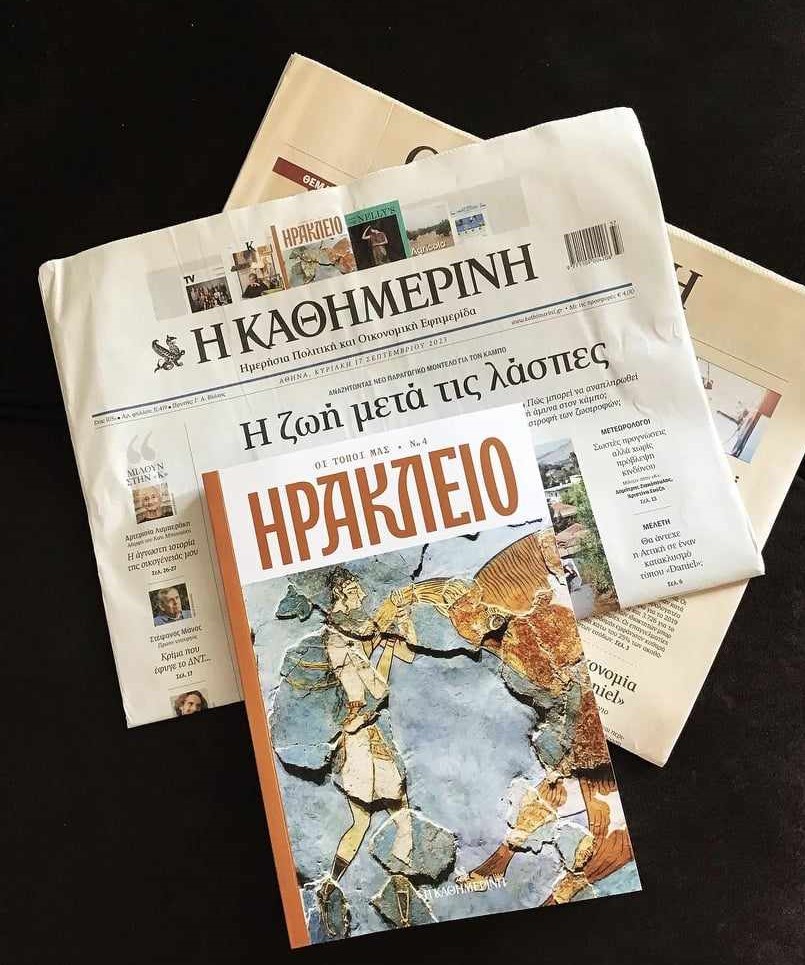
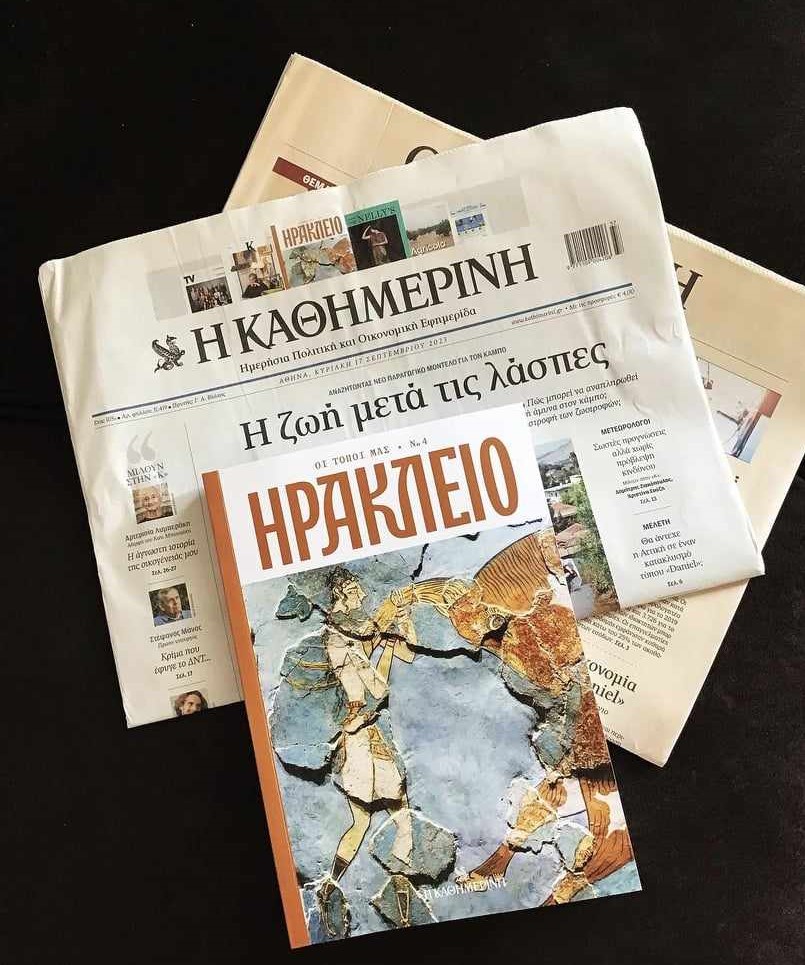
"Tradition opens roads". BH's work in KATHIMERINI newspaper
By Katerina Frentzou, Journalist, Founder of the cultural organization Branding Heritage
Branding Heritage cultural organization records, showcases and digitizes techniques that connect valuable elements of local heritage with the creative presence of Crete.
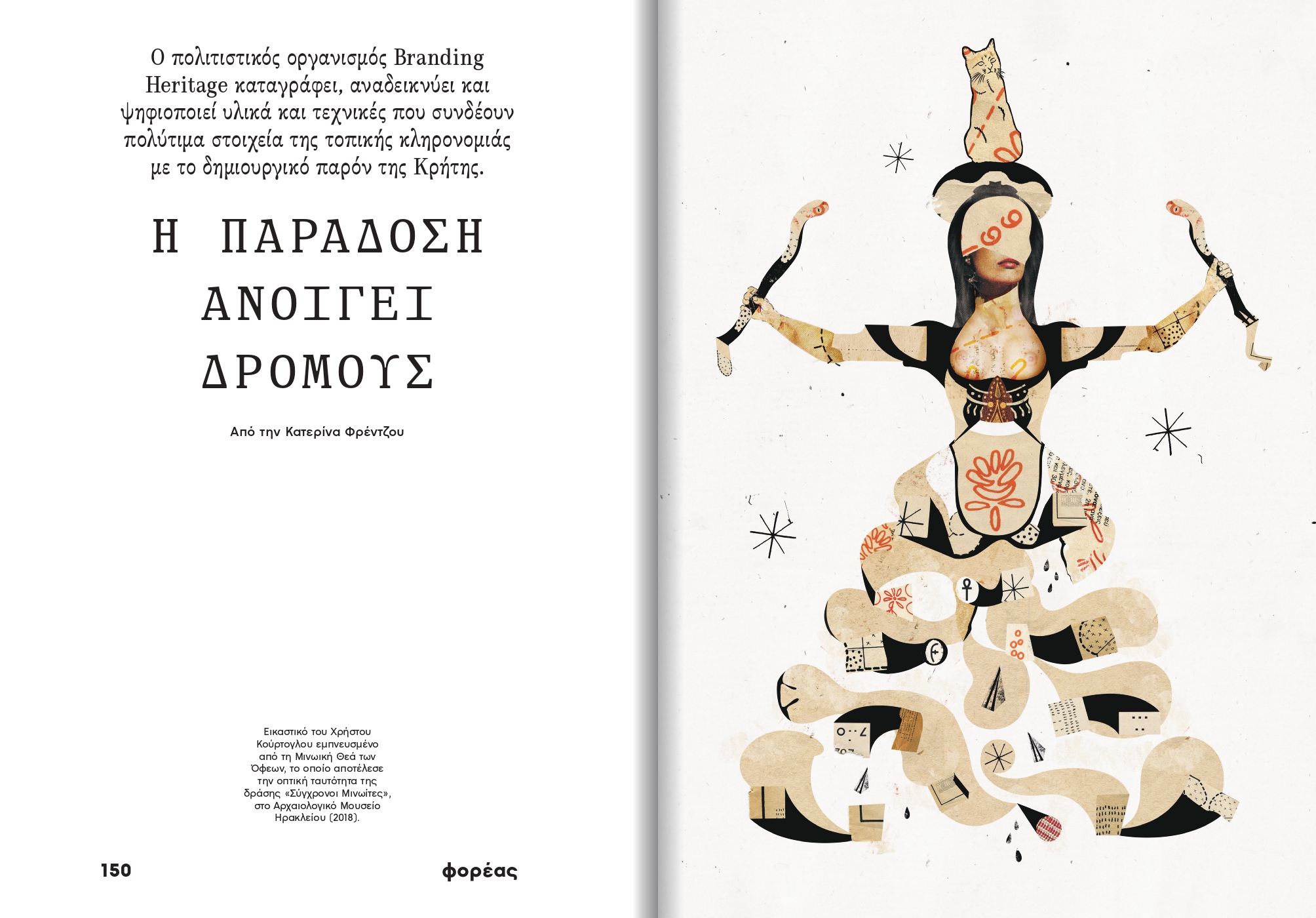
Tradition Opens New Paths
By Katerina Frentzou\
Katerina Frentzou
Journalist
Founder of the cultural organization Branding Heritage
The cultural organization Branding Heritage documents, highlights, and digitizes materials and techniques that connect valuable elements of local heritage with the contemporary creative present of Crete.
A personal connection with Crete
My connection with Crete begins with a unique experience at the archaeological site of Knossos, in April 2016. It is the first time I encounter in person what I had previously read about Evans’ excavation: the famous Minoan storage jars, the alabaster throne of the king. I stand in the middle of the palace’s central courtyard, gazing at 4,000 years of history.
A little further on, my attention is drawn to a slender man who seems almost to float, holding a paintbrush, under the gaze of thousands of visitors. A guide explains that he is Giannis Politis, the painter and conservator of the palace—an unsung worker of art who, for the past twenty years, has continued the chromatic restoration of the monument, guided by the precious knowledge passed down from his father.
“His art brought Knossos back to life. His dedication is deeply moving,” the Cretan guide tells me with admiration. “For years now, we have watched him paint until sunset, patiently and with absolute precision recreating the wooden structures on a concrete surface (2,350 sq. m.) from Evans’ restoration, seeking to give it a natural hue.”
A little later, he himself guides me into the inner sanctums of the palace. He speaks of Knossos as if it were his own home. Through his stories, I travel through time.
“The palace you see is only a small part of the Minoan treasures that have come to light. My father worked for Evans. He was a tireless conservator, and I have followed in his footsteps. I remember, as a small child, him pointing high up at the columns to the deep purple color. ‘This comes from a shell,’ he would say, his eyes sparkling with joy.
“He taught me to dive into the sea and collect the shell that would give me the authentic color of the Minoans. History and myths dwell in the time-worn limbs of the building, in the frescoes that celebrate the pride of the figure of the Prince of the Lilies. I serve this global monument with reverence, praying every day to be worthy of my role.”
MODERN MINOANS
As I leave, I find myself wondering how contemporary Minoan frescoes and symbols can truly be, and how they might connect with the present day. I search for the thread that links Minoan art and mythology with global artistic creation.
The examples are many: from Jean Cocteau’s famous Goddess of the Snakes to the contemporary serpent goddess by American artist Judy Chicago; from Jackson Pollock’s Pasiphaë to the Minotaur of William Blake and Pablo Picasso; and from Mariano Fortuny’s iconic Knossos Scarf (1907) to the digital prints of Minoan frescoes featured in Mary Katrantzou’s garments (2017). The grandeur of the Minoan past has long inspired artists and fashion designers around the world.
These observations lead me to design an initiative dedicated to Europe’s first civilization and the ways in which it can be translated into the creative present. “Modern Minoans” is realized through the cultural organization Branding Heritage (BH).
The two-day cultural event is held in Heraklion and Knossos in 2018 and travels to the Museum of London in 2019, with the support of the Region of Crete and the Greek National Tourism Organisation. Academics, creators, archaeologists, and journalists meet in May 2018 at the Heraklion Archaeological Museum and engage in an open dialogue on how heritage and tradition can serve as a springboard for creativity and entrepreneurship.
BH invites Greek designers to engage in dialogue with Minoan-era museum exhibits, creating contemporary objects that are displayed at the museum for one month. These works now belong to the BH Minoan Collection, which was recently digitized with the contribution of the Foundation for Research and Technology – Hellas (FORTH) and the support of the Hellenic Ministry of Culture.
From September 2023, the collection is available in three-dimensional form at the BH Digital Museum as well as in the digital repository of the National Documentation Centre.
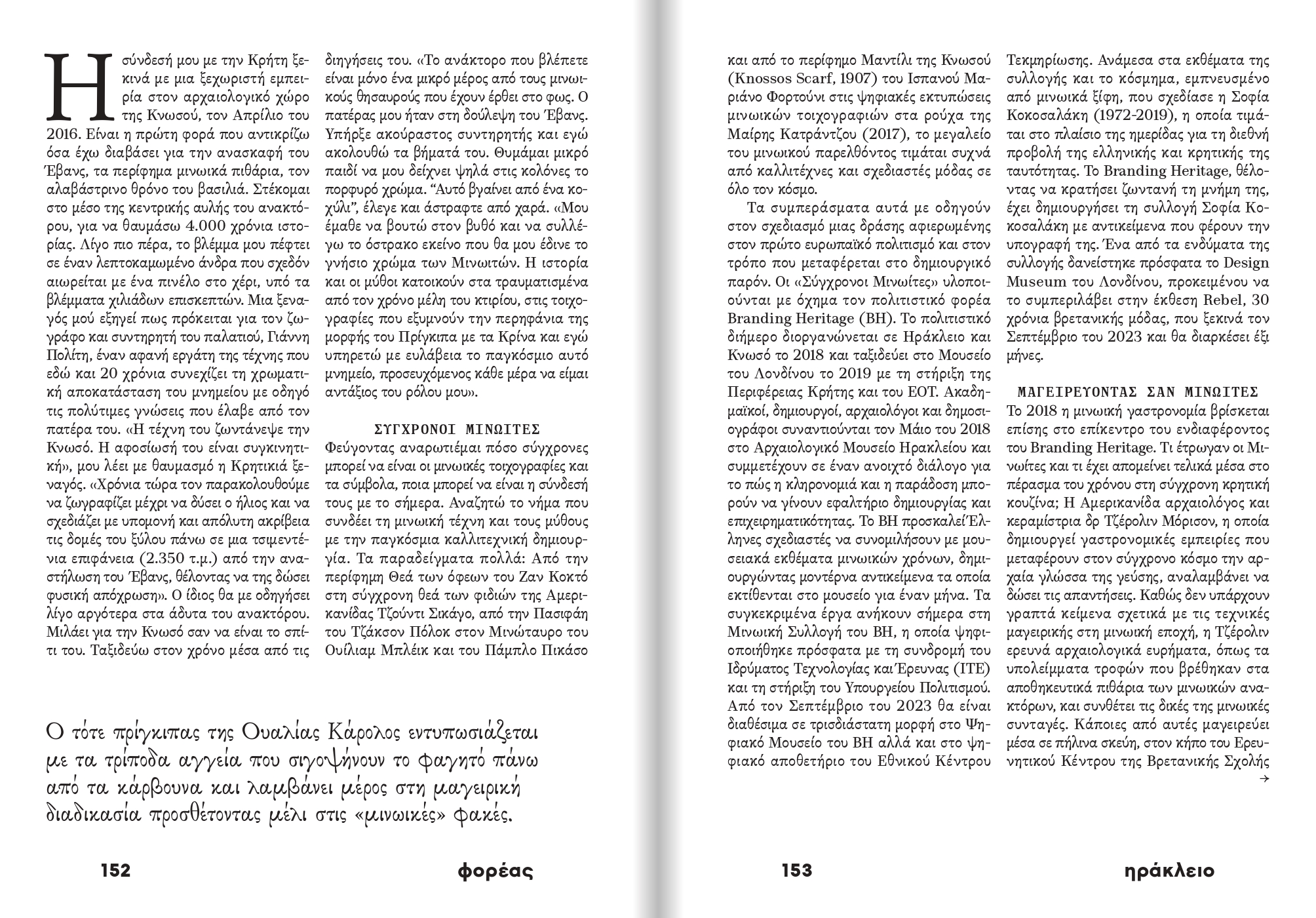
Among the exhibits is a piece of jewelry inspired by Minoan swords, designed by Sοphia Kokosalaki (1972–2019), who is honored as part of the conference dedicated to the international promotion of Greek and Cretan identity. In order to keep her memory alive, Branding Heritage has created the Sophia Kokosalaki Collection, featuring objects bearing her signature.
One of the garments from this collection was recently loaned to the Design Museum in London, to be included in the exhibition Rebel: 30 Years of British Fashion, which opens in September 2023 and runs for six months.
COOKING LIKE MINOANS
In 2018, Minoan gastronomy also comes to the forefront of Branding Heritage’s interest. What did the Minoans eat, and what has ultimately survived through time in contemporary Cretan cuisine?
American archaeologist and ceramicist Dr. Jerolyn Morrison, who creates gastronomic experiences that translate the ancient language of taste into the modern world, undertakes the task of providing answers. As there are no written sources describing cooking techniques from the Minoan era, Morrison studies archaeological findings, such as food residues discovered in the storage jars of Minoan palaces, and composes her own Minoan-inspired recipes.
Some of these are prepared in clay vessels, in the garden of the British School at Knossos, as part of the experiential initiative “Cooking Like Minoans”, held in Knossos in May 2018.
A distinguished guest of the British School is the then Prince of Wales, Charles, who is on the island as part of an official visit to Greece. The British royal is impressed by the tripod vessels slowly cooking food over glowing embers and takes part in the cooking process himself, adding honey to the “Minoan” lentils.
WEAVING TODAY
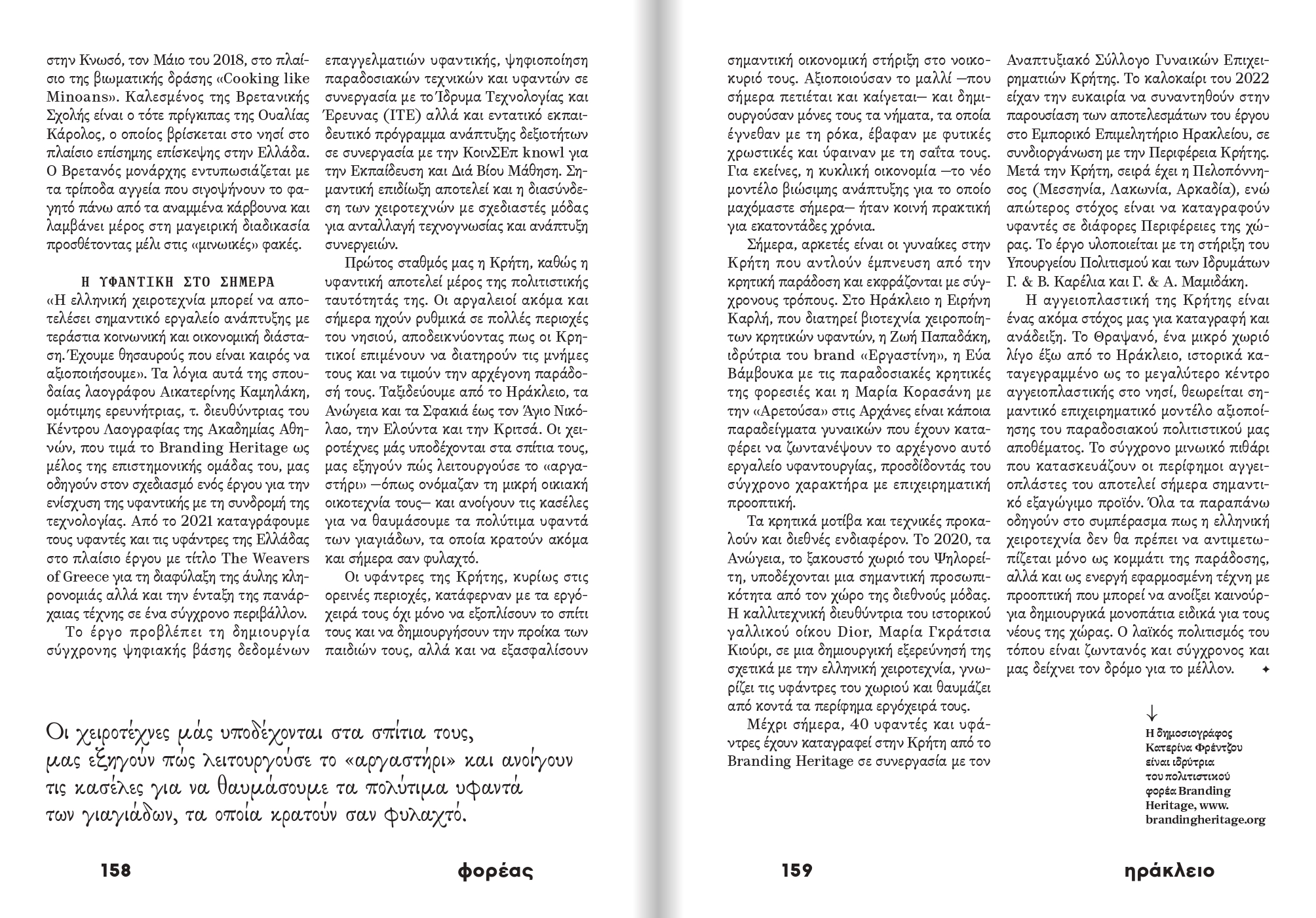
“Greek craftsmanship can become a significant development tool with enormous social and economic impact. We possess treasures that it is time to put to use.”
These words, spoken by the eminent folklorist Aikaterini Kamilaki, Emeritus Researcher and former Director of the Centre for Folklore of the Academy of Athens, whom Branding Heritage honors as a member of its scientific team, lead us to the design of a project aimed at strengthening weaving through the use of technology.
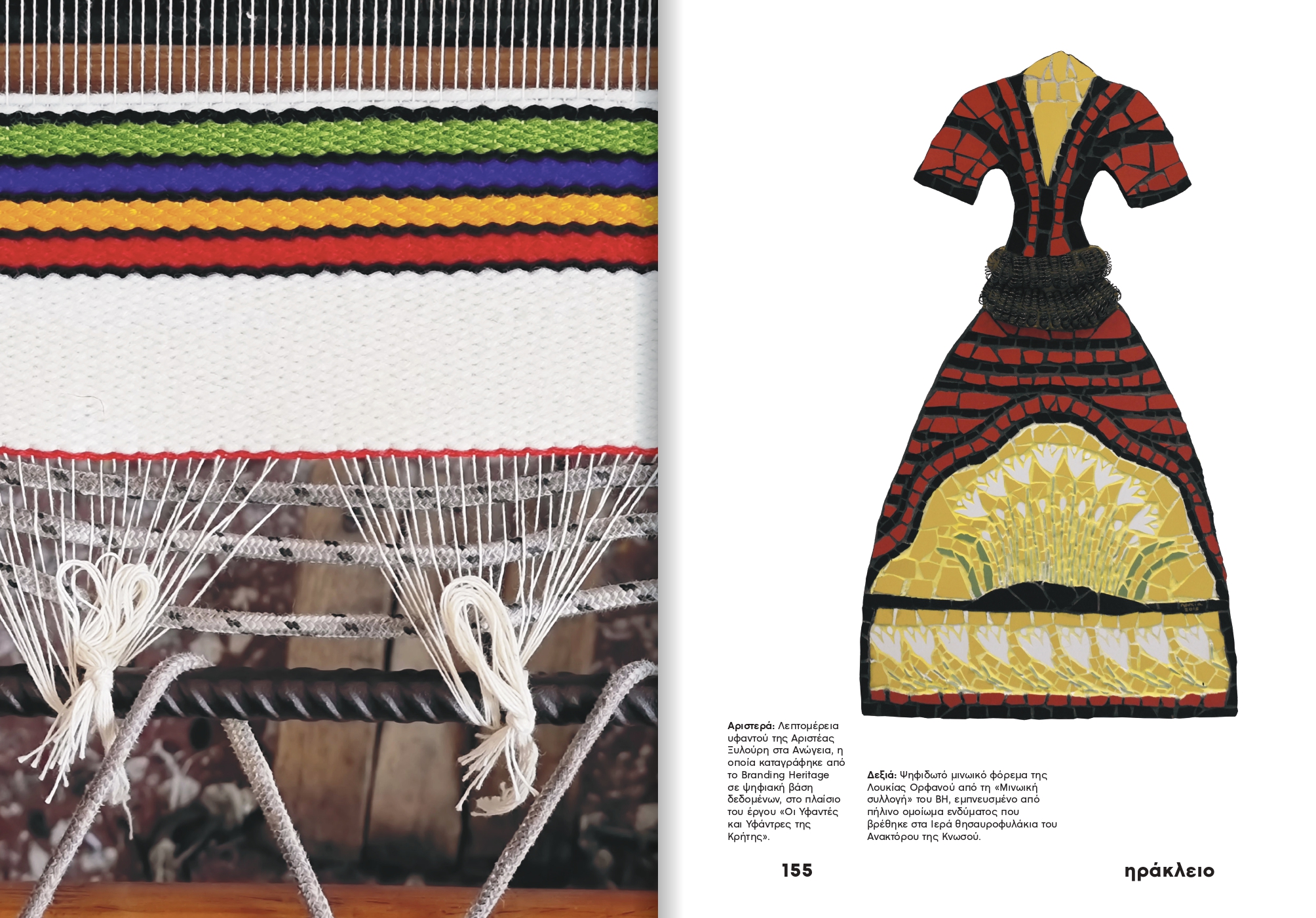
Since 2021, we have been recording the weavers of Greece as part of the project “The Weavers of Greece”, with the goal of safeguarding intangible cultural heritage while integrating this ancient craft into a contemporary context.
The project includes the creation of a modern digital database of professional weavers, the digitization of traditional techniques and textiles in collaboration with the Foundation for Research and Technology – Hellas (FORTH), as well as an intensive skills development training program in partnership with the social enterprise knowl, focusing on Education and Lifelong Learning. A key objective is also the connection of artisans with fashion designers, enabling the exchange of know-how and the development of collaborations.
Our first stop is Crete, as weaving forms an integral part of the island’s cultural identity. Even today, looms resonate rhythmically in many areas of the island, proving that Cretans persist in preserving their memories and honoring their ancestral tradition.
We travel from Heraklion, Anogeia, and Sfakia to Agios Nikolaos, Elounda, and Kritsa. Artisans welcome us into their homes, explain how the “argastiri”—as they called their small domestic workshops—functioned, and open their chests for us to admire the precious textiles of their grandmothers, which they still cherish today as talismans.
THE WEAVERS OF CRETE
Tradition as a Living Economy
The weavers of Crete, particularly in the mountainous regions, managed through their handiwork not only to equip their households and create dowries for their children, but also to secure significant financial support for their families.
They made use of wool—which today is often discarded or burned—and created their own threads, spinning them with the distaff, dyeing them with plant-based pigments, and weaving them on their looms. For these women, the circular economy—the contemporary model of sustainable development for which we strive today—was a common practice for hundreds of years.
Today, many women in Crete draw inspiration from local tradition and express it through contemporary means. In Heraklion, Eirini Karli, who runs a workshop of handmade Cretan textiles; Zoi Papadaki, founder of the brand Ergastini; Eva Vamvouka, known for her traditional Cretan costumes; and Maria Korasani with Aretousa in Archanes, are just some examples of women who have succeeded in reviving this ancient weaving tool, giving it a modern character with entrepreneurial perspective.
Cretan motifs and techniques have also attracted international interest. In 2020, Anogeia, the renowned village on Mount Psiloritis, welcomed a prominent figure from the world of international fashion. Maria Grazia Chiuri, Artistic Director of the historic French fashion house Dior, visited the village as part of her creative exploration of Greek craftsmanship, met the local weavers, and admired their remarkable handiwork firsthand.
To date, 40 weavers in Crete have been recorded by Branding Heritage, in collaboration with the Development Association of Women Entrepreneurs of Crete. In the summer of 2022, they had the opportunity to come together during the presentation of the project’s results at the Heraklion Chamber of Commerce, co-organized with the Region of Crete.
Following Crete, the project continues in the Peloponnese (Messinia, Laconia, Arcadia), while the ultimate goal is to document weavers across various regions of Greece. The project is implemented with the support of the Hellenic Ministry of Culture and the G. & V. Karelias Foundation and the G. & A. Mamidakis Foundation.
Beyond Weaving
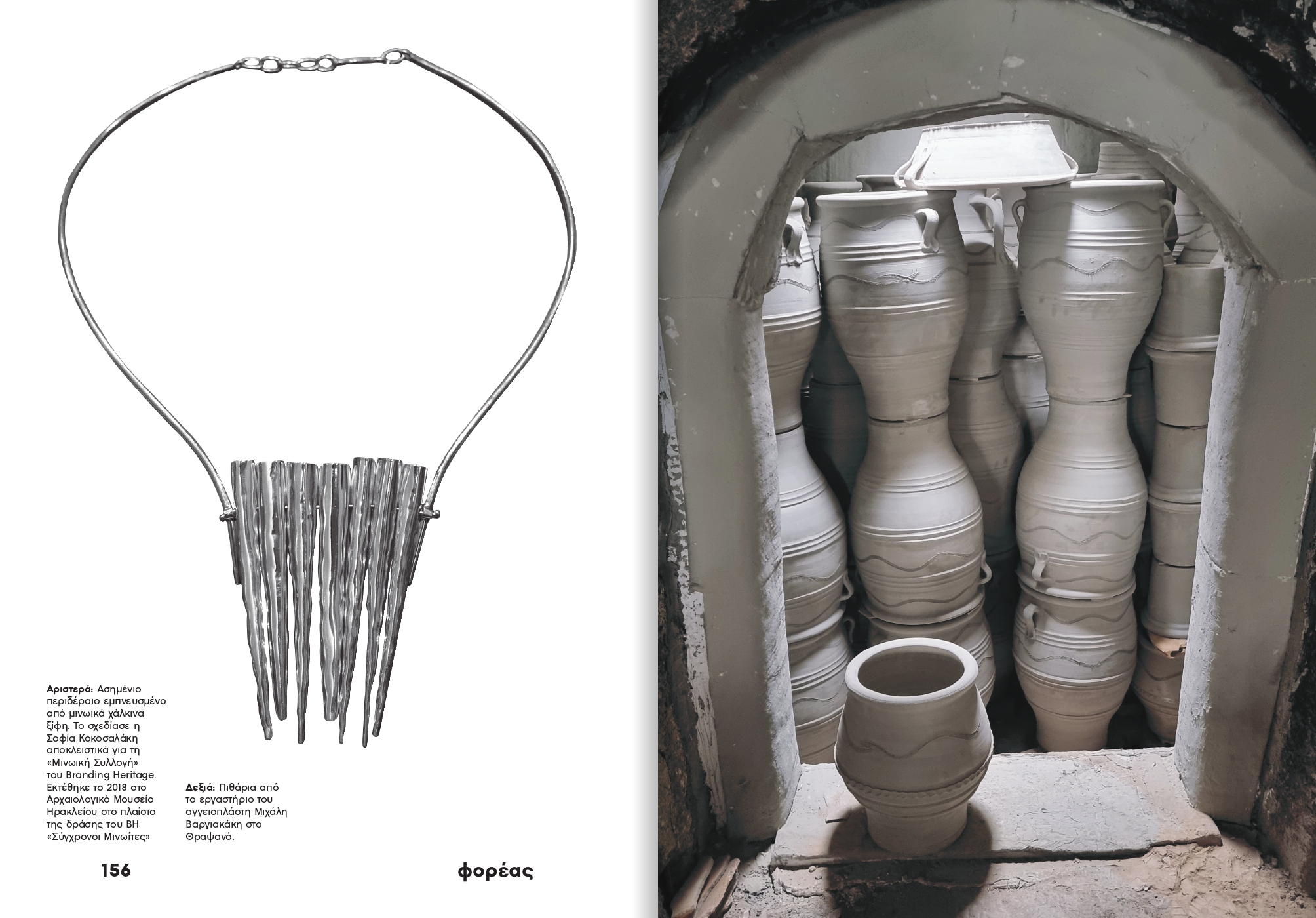
Cretan pottery is another field we aim to document and highlight. Thrapsano, a small village near Heraklion, historically recorded as the largest pottery center on the island, is considered a significant entrepreneurial model for the utilization of our traditional cultural resources. The contemporary Minoan pithos produced by its renowned potters is today an important export product.
All of the above lead to the conclusion that Greek craftsmanship should not be viewed solely as part of tradition, but as a living, applied art with future potential—one that can open new creative pathways, especially for the country’s youth.
Local folk culture is alive and contemporary, and it shows us the way forward.